
Language Requirement: None
Academic Standing by Program Start: Sophomore or above
Location: Europe, Italy
GPA: 2.5

Architecture in Rome

Program Overview

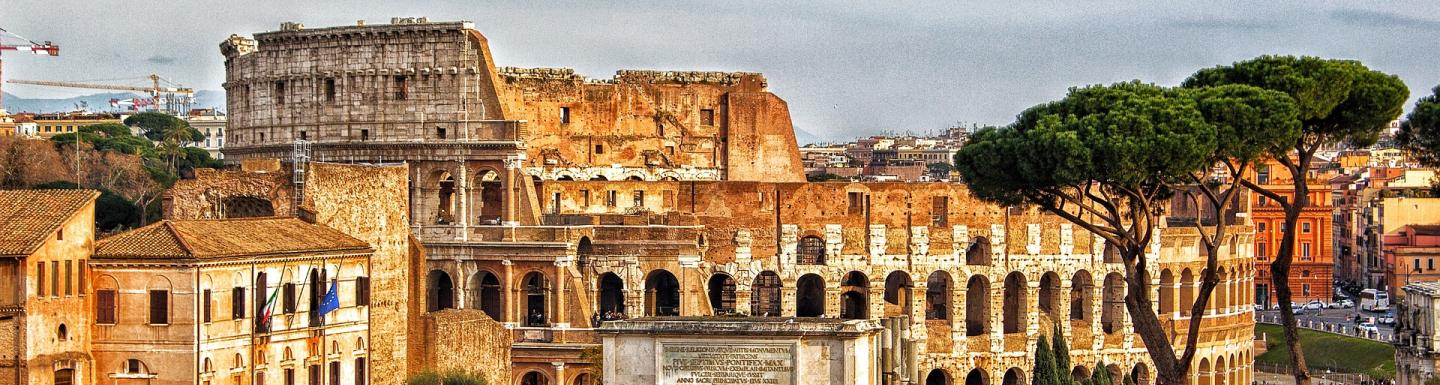
Experience layers of history and space surrounded by a vibrant design culture through the architecture, interior architecture, and urban design of Rome. Walk through the ancient forums, sketch masterpieces of art and architecture from Ancient to Renaissance and Modern eras and learn from local and international experts about the design process and rivalries between the patrons, artists, and architects who shaped the city. See how buildings, interiors, streets, and plazas continue to sustain lively interaction in one of the world's most dynamic and eternal cities.

Talking about Rome, where eyes are caught by the beauty of design through the ages of history. The concept of Strata (Latin: Stratum, meaning layer) captures a defining feature of contemporary Rome, that every block in the city is an ancient site, underneath an imperial site, underneath a medieval site, underneath a Renaissance or Baroque site. Centuries have passed, but these buildings still hold within them elements that speak to life.

The eight-week program includes two separate multi-day excursions, as well as day trips and walking tours in and around Rome. Students will observe how Italian daily life, urban spaces, buildings, and interior spaces are interwoven and how they sustain vibrant interactions in one of the world’s most dynamic and enduring cities.

Courses are offered for both interior architecture and architecture credits. On-site explorations are integrated with the history and media courses led by faculty and guest lecturers. Students will examine how buildings relate to their context and programmatic requirements. Other focus points include architectural elements, materials, and their characteristics, with attention to how these elements contribute to function, meaning, and aesthetics. 

This is a rolling admission program. Early applications are encouraged.

Program Scholarship: Applicants to this program have the option to apply for a program-specific scholarship. Award recipients are chosen based on academic merit, financial need, and overall quality of their essay. Individual awards range from $500 - $1,000. To be considered, the Scholarship Essay must be completed by February 15th. Please refer to the Scholarship Essay instructions in the program application or speak with your GEO advisor for more details.

Dates and Deadlines

Term Year Deadline Arrival Date Departure Date
Summer 2027 03/01/2027 06/21/2027 08/14/2027

This program has a rolling admission application process: GEO staff (and the program faculty leader, if applicable) will complete a review of the application materials of complete applications in the order that they are submitted (“first come, first serve”). Decisions about acceptance will be made shortly after you submit a complete application. There are some programs that fill fast, some even before the deadline. Students are encouraged to complete applications and commit to programs early. 

Acceptance is based on a holistic review of your application.  This includes a review of your GPA, transcripts (including courses taken and in-progress), any additional requirements or prerequisites (see section "Additional Requirements"), and the short statement.

This program is less than 90 days. Students with a US passport will be traveling to Italy under the Schengen Visa waiver program and do not require a travel visa for this program, and GEO is unable to assist U.S. citizens in obtaining a visa. If you are not a U.S. Citizen: Notify your GEO Advisor. Students who are not U.S. citizens should contact the Italian consulate in their country of residence about visa requirements, no matter the duration of the program of study.

Hear from Our Students

Rome offered the perfect backdrop to study architecture, with a mix of both ancient and modern precedents. Studying abroad gave me the opportunity to experience culture and architecture from a very… read more

Faculty-Led Scholarship Opportunity

Applicants to this program are eligible for program-specific scholarship funds. Award recipients are chosen based on academic merit, financial need, and overall quality of their essay. Individual awards range from $500-$1,500. To be considered, apply to the GEO General Scholarship by the advertised deadline for the term you will be abroad. Students who apply will automatically be considered for all available funding within the General Scholarship, including this program's scholarship funds.

Discount for Pell Recipients

To expand access to study abroad, GEO is offering a $500 discount for this program to UO students who currently have the Pell Grant as part of their federal financial aid (FAFSA).

Academic Details

Enroll in three courses for 12 summer quarter credits or 9 summer semester credits.

ARCH 484/584: Design Studio in Rome (341) - 6 credits

The studio will use the past as a resource to explore contemporary themes of housing, materials, and detailing. These investigations focus on the evolution of the Roman house—the single-family townhouse (domus) and the multi-story apartments and community housing (insulae)—examining their potential for adaptability and distinct transformations of space under new programs.  Students will use historic examples as a starting point to develop their contemporary studio projects. The studio will begin with an analysis of selected sites—such as Ostia Antica, Theatre of Marcellus, Trajan’s Market, Case Romane Del Celio, The Capitoline Insula, Villa Adriana, Villa D’Este, and artifacts in museums. In the main part of the studio, the focus then shifts to developing their own projects on the theme of dwelling, with particular attention to adaptive reuse. Students will work in a variety of scales, down to a detailed room. There will be a combination of individual and group projects.

ARCH 423/523: Media for Design Development (340) - 3 credits

For Architecture majors, this course fulfills the ARCH 4/523 Advanced Media or subject area elective. For Art History majors, this course fulfills the undergraduate Studio Art requirement and graduate elective. In the field, students will practice ways to capture and interpret environments using a variety of art and design media. Capturing a place means recording unique impressions, perceptions and memories along with physical characteristics. The class will examine how light, form and materials make a place distinctive and how qualities can be conveyed with traditional and experimental methods. The goal of the course is to help students refine techniques for personal expression and for studio application. Through demonstrations and exercises, students will learn about freehand drawing, measured drawings and watercolor techniques. Students will use historical and contemporary examples both as models and springboards for exploration. In particular, students will explore the new urban axis from the Chiesa Nueva to the top of the Gianicolo in various media forms.

ARCH 407/507: The City of Rome (337) - 3 credits

This course will use the magnificent architecture of Rome and its environs to help students understand the broad historical trajectory of western culture. We will explore the rise of the Roman empire, the impact of Christianity on in the late antique and medieval periods, the dramatic innovations of the Italian renaissance, and the Fascist architecture and cosmopolitan modernism of the twentieth and twenty-first centuries.  This course, which involves numerous walking-tours and site visits, will not only give students first-hand familiarity with some of the globe’s most iconic architectural monuments (the Colosseum, the Sistine Chapel), but it will reveal the importance of considering the meaning of those architectural monuments within the historical context of their production as well as their subsequent “life” within the evolving landscape of the Eternal City.  By learning to think about the past and present meanings of the city’s neighborhoods, palaces, churches and museums, students will gain a deeper understanding of Rome as a city and the importance of historical inquiry within modern society. The role of migration to Rome in history may be a special topic connecting it with the studio. The course will be taught by a guest professor(s) in Europe.

Courses will satisfy requirements in Architecture, Interior Architecture, Landscape Architecture, and Product Design.  ARCH 4/507: City of Rome satisfies Architectural History.  For Interior Architecture majors this course satisfies Western Architecture History or Subject Area Elective.

Course Equivalencies

UO students: please refer to the UO Course Equivalency Process and the UO Office of the Registrar Course Equivalency Database.

Non-UO students: Actual credit awarded is determined by the relevant department at your university in consultation with the study abroad office. Check with your study abroad advisor for more information.

Additional Requirements

This program is suitable for Architecture majors. For all other College of Design majors, please consult with your academic advisor before applying for this program.

  • Students need to be eligible for the 400-level studio sequence and have completed ARCH 283, 284,383, 384 by the time the program begins.  For Interior Architecture majors, Arch 484 will fulfill the 384 requirement. 


Graduate Students: Must have a 3.0 GPA or above to participate in the program.

Faculty and Staff

Image  

Professor Esther Hagenlocher, Head, Department of Interior Architecture:

Professor Hagenlocher previously led the Rome program in 2023 and was a visiting faculty in 2026.  Her research interests include Fritz-Seitz-Archive; Color Studies - Perception and Performance; Gestalt and Composition; and Furniture and Material.

Housing Description

The University of Oregon partners with the University of Washington Rome Center on this program. Founded in 1985, the UW Rome Center is located in the ancient heart of Rome just off the Campo de’ Fiori. The UWRC offers highly-trained local staff to facilitate transformative learning experiences for students and one-of-a-kind teaching and research opportunities for faculty. 

Student accommodations are located in the heart of Rome, within a 10-minute walk of the UWRC. Apartments typically have one to three bedrooms, kitchen, living room/common area, and one or more bathrooms. Bedrooms are usually shared with one or two other students, including one single bed per student and closet/clothing storage space.

All apartments are furnished and have a fully-equipped kitchen including standard Italian kitchenware, washing machine and drying rack.  Bed, bath and kitchen linens are provided. Apartments are cleaned regularly by a professional cleaning service.

Budget and Price

Global Education Oregon Logo

Architecture in Rome

2026 Summer

GEO Program Fees
Description Amount
UO Study Abroad Fee $500
Program Tuition $7,172
Housing & Included Meals $2,668
Local Transportation $457
Insurance $203
Estimated Additional Expenses
Description Amount
Estimated Airfare from Eugene $1,800
Estimated Additional Meals $750
Estimated Cell Phone Expenses $100
Estimated Cost of acquiring passport $150
Estimated Additional Living Expenses $750
Total
Description Amount
Sub-Total: Program Fees (Billed to UO Student Account) $11,000
Sub-Total: Estimated Additional Expenses $3,550
Total Estimated Cost of Participation $14,550

Cancellation Policy

Cancellation Date Cancellation Penalty
Upon acceptance to program

Student agrees to $500 non-refundable program deposit

Cancelling within 8 weeks of the program start date

Student is responsible for 50% of total GEO program fees 

Cancelling on or after the program start date

Student is responsible for 100% of total GEO program fees