Language Requirement: None
Academic Standing by Program Start: Sophomore or above
Location: Americas, Ecuador
GPA: 2.5

Tropical Ecology in Ecuador

Program Overview

20200225_SustainableGoals_ClimateAThe tropics, which occupy about seven percent of the Earth’s surface, contain the bulk of our biodiversity. Unfortunately, they are also the regions that are experiencing some of the highest rates of destruction. The destruction of tropical systems has many adverse consequences including drastic changes in regional and global climate patterns and loss of potentially important medicinal compounds and other useful products. There still exists an immense amount of knowledge to be gained from studying tropical ecosystems and a desperate need for more experts in the field of tropical biology. 

Learn more about this program at the info session: Wednesday, November 18, at 5 p.m. in 125 Huestis Hall

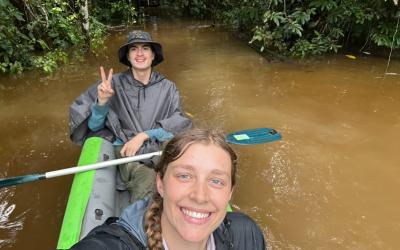
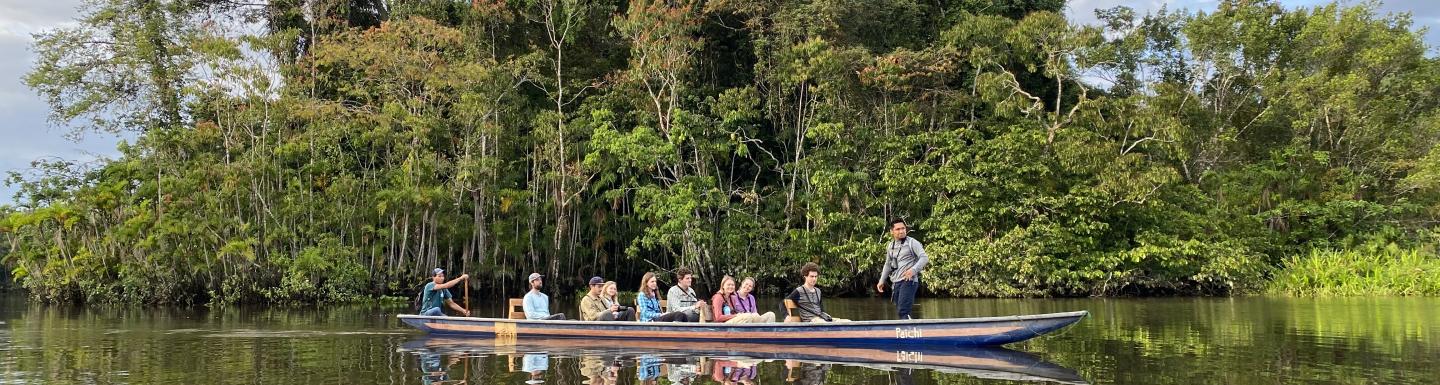
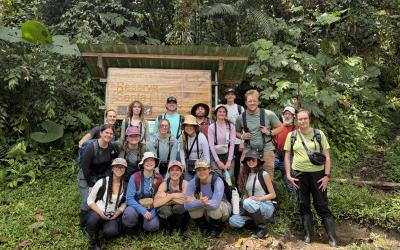
Spend three weeks exploring the extraordinary biodiversity of Ecuador, from the Amazonian lowland rainforest to lush Andean cloud forests and the high-elevation páramo! The Tropical Ecology in Ecuador program offers an immersive field experience in three remarkable ecosystems: the Amazonian lowland rainforest, cloud forest, and high-elevation Andes. Students will encounter fascinating plants and animals, learn to identify tropical organisms, and gain hands-on experience conducting ecological research in some of the most biodiverse landscapes on Earth. Students will work alongside Ecuadorian biologists and local naturalist guides, gaining insight into tropical ecology, conservation, and the relationships between biodiversity and local communities.

Whether you’re interested in ecology, conservation, biodiversity, or experiencing the natural world in a new way, this program offers a unique opportunity to learn biology beyond the classroom.

See the program in action!

Explore the biodiversity documented by our students on iNaturalist!
Dates and Deadlines

Term Year Deadline Arrival Date Departure Date
Summer 2027 02/15/2027 06/13/2027 07/03/2027

This program has a rolling admission application process: GEO staff (and the program faculty leader, if applicable) will complete a review of the application materials of complete applications in the order that they are submitted (“first come, first serve”). Decisions about acceptance will be made shortly after you submit a complete application. Some programs fill fast, some even before the deadline. Students are encouraged to complete applications and commit to programs early.

Acceptance is based on a holistic review of your application.  This includes a review of your GPA, transcripts (including courses taken and in-progress), any additional requirements or prerequisites (see section "Additional Requirements"), and the short statement.

Hear from Our Students

My three-week study abroad experience in Ecuador was one of the most memorable experiences I have had in college. Our group visited Quito, various eco lodges, Artisana National Park, and the Amazon… read more
Image If you are on the fence about studying abroad — go! I spent three weeks in the cloud forests, highlands, and rainforests of Ecuador and it… read more

Faculty-Led Scholarship Opportunity

Applicants to this program are eligible for program-specific scholarship funds. Award recipients are chosen based on academic merit, financial need, and overall quality of their essay. Individual awards range from $500-$1,500. To be considered, apply to the GEO General Scholarship by the advertised deadline for the term you will be abroad. Students who apply will automatically be considered for all available funding within the General Scholarship, including this program's scholarship funds.

Discount for Pell Recipients

To expand access to study abroad, GEO is offering a $500 discount for this program to UO students who currently have the Pell Grant as part of their federal financial aid (FAFSA).

Academic Details

Earn 8 upper-division Biology (BI) credits through two complementary courses combining hands-on field experiences with ecological research.

Tropical Ecology Field Projects (4 graded credits): Students develop and conduct ecological research projects, maintain field journals documenting their observations and discoveries, and present their findings to their peers. Mandatory preparatory meetings beginning in spring introduce ecological concepts, research methods, and organisms students will encounter in Ecuador.

Tropical Ecology Field Studies (4 Pass/No Pass credits): Students explore Ecuador’s biodiversity through guided field excursions, organism identification, ecological field techniques, and presentations by biologists and naturalist guides.

The 8 upper-division BI credits can contribute toward several UO degree requirements:

• Biology: Upper-division Biology credits, laboratory/field requirement, BI 420–499 credits, and Ecology & Evolution emphasis area.

• Marine Biology: Upper-division Biology credits, BI 420–499 credits, and Ecology & Evolution emphasis area.

• Environmental Science and Environmental Studies: Area 3A Natural Science requirements. 

• Multidisciplinary Science: Approved upper-division science credits.

• College of Arts and Sciences: Credits toward the 62-credit upper-division graduation requirement.

Students should consult their academic advisors to confirm how courses apply to their individual degree plans.

Course Equivalencies

UO students: please refer to the UO Course Equivalency Process and the UO Office of the Registrar Course Equivalency Database.

Non-UO students: Actual credit awarded is determined by the relevant department at your university in consultation with the study abroad office. Check with your study abroad advisor for more information.

Additional Requirements

Academic prerequisites: Completion of UO BI 223Z, BI 283H, or an equivalent course by the end of spring term, or approval of the faculty leader. Completion of at least 25 college credits by the program start date.

Physical activity: This is an active, field-based program that includes hiking on uneven terrain, sometimes at high elevations and in hot, humid tropical environments. Students should be prepared for regular outdoor activities under a variety of conditions.

Students with questions about physical requirements or accessibility are encouraged to contact the program faculty leader to discuss activities and available accommodations.

Faculty and Staff

The program is led by Dr. Tobias Policha, Associate Teaching Professor of Biology at the University of Oregon. Dr. Policha has over 25 years of experience studying plants and ecology, including extensive field research in Ecuador’s tropical forests. His research has focused on plant–pollinator interactions, particularly the pollination biology of Dracula orchids in Ecuador’s Andean cloud forests.

Students will also learn from Ecuadorian biologists and local naturalist guides, who bring extensive knowledge of the country’s biodiversity, ecosystems, and conservation.

Learn more about Dr. Policha: https://linktr.ee/tobiaspolicha

Housing Description

Students will stay in hotels while in Quito and in shared, dormitory-style accommodations at research stations and lodges while exploring Ecuador’s tropical ecosystems. Many of these accommodations are located in remarkable natural settings, providing opportunities to experience tropical biodiversity beyond scheduled field activities.

Most meals will be enjoyed together as a group. All but four meals are included in the program fee. Vegetarian options are available, although vegan meals may not always be possible, particularly at remote field stations.

Students with dietary restrictions or accommodation questions are encouraged to contact program staff before applying.

Budget and Price

Global Education Oregon Logo

Tropical Ecology in Ecuador

2027 Summer

GEO Program Fees
Description Amount
UO Study Abroad Fee* $500
Program Tuition $3,396
Housing & Included Meals $2,520
Transportation $810
Insurance $74
Estimated Additional Expenses
Description Amount
Estimated Cost to Acquire US Passport $150
Estimated Airfare from Eugene $1,500
Estimated Meal Expenses $100
Estimated Cellphone Expenses $100
Estimated Additional Living Expenses $300
Total
Description Amount
Sub-Total: GEO Program Fees (Billed to UO Student Account) $7,300
Sub-Total: Estimated Additional Expenses $2,150
Total Estimated Cost of Participation $9,450

Cancellation Policy

Cancellation Date Cancellation Penalty
Upon acceptance to the program

Student agrees to $500 non-refundable program deposit

8 weeks before program start date

Student is responsible for 50% of total GEO program fees

Program start date or after program begins

Student is responsible for 100% of total GEO program fees